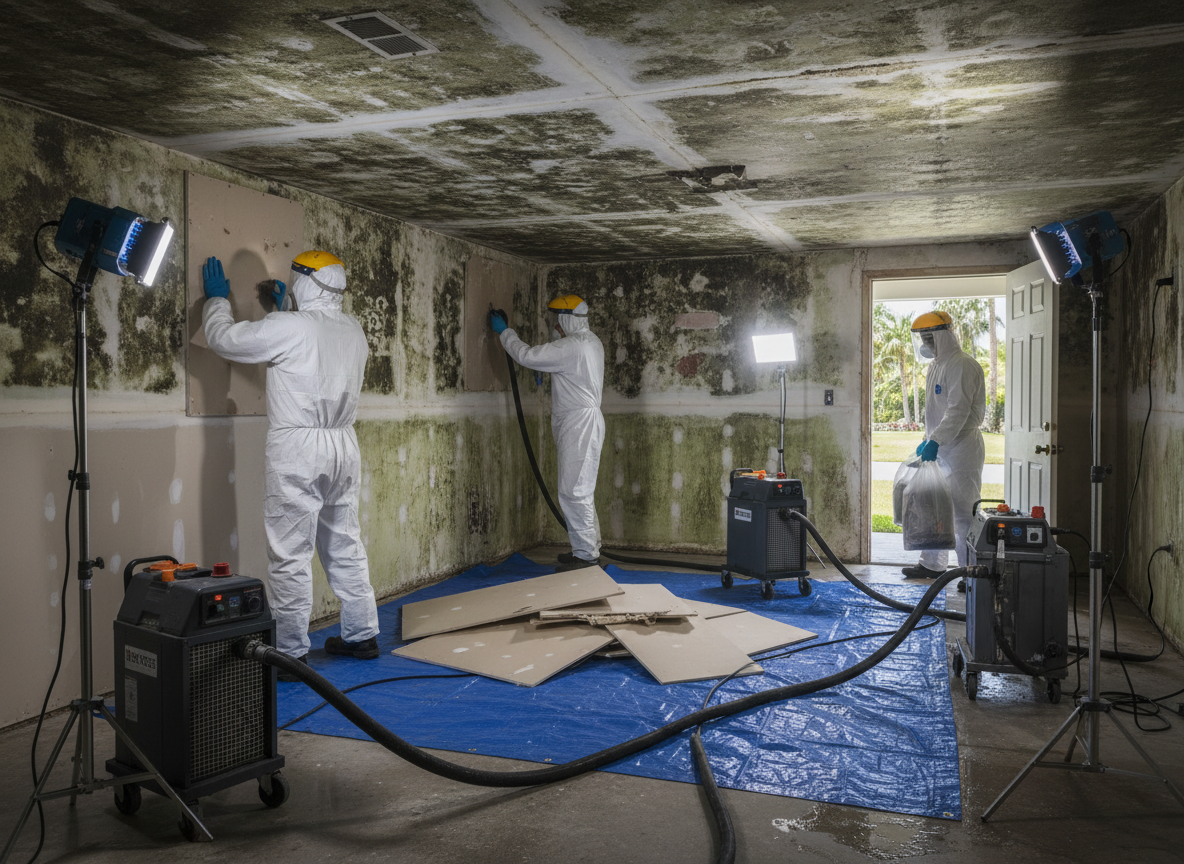
Loxahatchee is a large-lot community at the western edge of Palm Beach County, and a water loss here is rarely confined to one room. A leak in a barn, a workshop or a guest building can run for days before anyone notices, and the same parcel may have a well, a septic system and a canal at the end of the drive. This page explains what we look for at a Loxahatchee address.
What should a Loxahatchee homeowner know first?
The first thing to know is that the building and the land are one system here. Water that leaves a supply line, a roof or a wash rack has somewhere to go on a large lot, and that is often into the ground beside the house, a detached garage or a barn rather than into a visible puddle. Read the building before assuming the leak is small.
Loxahatchee is unincorporated, so there is no city hall to call about a drainage problem in the street. The Indian Trail Improvement District maintains the canals and many of the roads across this part of the county, and Palm Beach County handles building permits, plan review and code enforcement. That division matters when the cause of a water problem is outside the house.
What shapes a water loss on a Loxahatchee lot?
Four things repeat on the properties we are asked to assess: the canal system, the size and age of the buildings, the ground itself, and who is responsible for the infrastructure around the address.
Drainage depends on canals, not on slope
Loxahatchee is flat, and it drains through a canal network rather than by running downhill. The Indian Trail Improvement District maintains about 164 miles of canals, more than 458 miles of roads and nine rural and equestrian parks across its service area. In a heavy summer storm those canals rise and the ground saturates, and a lot that looks dry can be holding water a few inches down. A house pad that sits only slightly above the surrounding grade gives water a short path to the wall base, the garage slab or a lanai.
Large lots mean more buildings to check
A Loxahatchee parcel is commonly an acre or more, and it often carries more than one structure: a house, a detached garage, a workshop, a barn, a tack room, a feed room and sometimes a guest unit. Each has its own supply lines, its own roof and its own shutoff. A leak in a workshop or a barn is easy to miss because those buildings are not lived in every day, and a wet feed room or tack room holds moisture in materials that cannot simply be wiped dry.
Sandy soil, a high water table and private services
Much of western Palm Beach County sits on sandy soil over a water table that stays close to the surface, especially in the wet season. Water moves sideways through that soil rather than sinking quickly, so a leak beside a foundation can reappear under a different wall. Many Loxahatchee properties also run on a private well and a septic system. A water loss near the well head or the drain field is a different problem from a leak in a hallway, and it needs to be assessed with those systems in mind.
Who serves the address
Loxahatchee is unincorporated Palm Beach County. Building permits and inspections go to the county, the Indian Trail Improvement District handles drainage and many roads, and law enforcement and fire rescue are provided by the county. If a canal is blocked or a road floods, the district is the relevant body; if a wall has to be opened, the county is the permitting authority. Knowing which is which prevents a repair from being designed around the wrong owner. A detached garage that shares the house's water service is the most common example: the line runs underground, the leak starts at a fitting, and the first sign is a damp patch on the garage slab rather than a puddle in the yard. When we walk a Loxahatchee parcel, we ask which buildings share a meter and where the shutoffs are, because that is what decides how quickly the water can be stopped.
What does a Loxahatchee property need from us?
A Loxahatchee job usually starts with a walk of the whole parcel, not just the wet room, because the source is often in a building the owner was not thinking about.
When water has entered from rain, a roof opening, a door track or a canal that rose, water damage restoration covers water removal, extraction, storm damage and leak detection. On a large lot, the extraction phase matters as much as the pump-out: water held in a barn's timber, a tack room's stored feed or a workshop's insulation will not leave because the floor looks dry. We mark the wet boundary in each building and dry against those readings.
When a wall, a ceiling or a tack room has stayed damp long enough to smell, mold damage restoration is the next step. Containment is important in a detached building because the work area may be next to feed, bedding, leather or equipment that should not be exposed to dust. We seal the work area, filter the air and remove material that cannot be saved.
Because a Loxahatchee property may have a well and a septic system, we also ask where the water went. A leak that has been running beside a drain field, a well head or a pump house is not just a building problem, and we will say so rather than drying a room and leaving the cause in the ground.
Why use us in Loxahatchee?
Because a large-lot property needs a walk of every building, not a look at one wet room. We work from 12841 Meadow Breeze Dr in Wellington, about two miles from Loxahatchee, and we ask which structures are on which shutoff before the visit. We separate the water work from well, septic, plumbing, roofing and rebuild work, and we put the readings and the scope in writing. We publish only the facts this business has supplied.
Why does a Loxahatchee leak get worse quickly?
Because the climate does not give the building a chance to dry. Relative humidity stays high for most of the year, the rainy season runs from June through November, and the air conditioning keeps interior surfaces cool enough to condense moisture. A damp wall cavity in July is unlikely to dry in August, and growth can begin on a damp surface in about a day or two.
The land adds to it. When the canals are high and the ground is saturated, water that would otherwise drain away from a foundation has nowhere to go. A leak that starts in a laundry room or a barn wash rack can keep feeding the same wall base long after the rain stops. On a property with a well, a running leak can also affect the pump and the pressure system, which is why the water has to be stopped at the source rather than managed with towels.
Delay changes the scope from a room to a building. A small leak in a workshop may mean drying insulation and a wall base; left through a wet season, it can mean removing cabinets, a section of drywall and a floor assembly, and the contents of the building have to be handled as well.
How does a job in Loxahatchee run, step by step?
- Call and safety guidance. Tell us which buildings are wet, where the water came from and whether the property is on a well. We tell you what to shut off and which areas to keep clear.
- Walk the parcel. We read the house and every outbuilding that could be on the same water service, and confirm whether the source is still active.
- Write the scope. The scope separates the building work from well, septic, plumbing, roofing and rebuild work.
- Remove and extract. Standing water, saturated material and water held in timber or insulation come out.
- Dry against readings. Equipment runs at marked points until each building reaches a dry standard.
- Verify and hand back. Final readings are compared with day one, and the record names any other trade that owns a repair.
What's included in a Loxahatchee job
- A moisture survey of the house and any affected outbuilding
- A check of the water service, shutoffs and the well or pump area where relevant
- Extraction of standing water and removal of saturated material
- Containment and air filtration where growth is disturbed
- Drying equipment positioned against marked readings
- A written record of readings before and after
- A named hand-off for plumbing, well, septic, roofing or rebuild work
Which nearby areas do we cover from Loxahatchee?
Loxahatchee Groves, The Acreage, Royal Palm Beach and Wellington are all within about ten miles of our Wellington base, and we cover each one. Loxahatchee Groves and The Acreage share the same canal-and-lot pattern; Royal Palm Beach and Wellington are more densely built and drain through their own systems. Each has a separate page because the housing and the water pattern differ.
What should you do next?
Call (561) 960-0937 and tell us which buildings are wet, whether the property is on a well and where the water first appeared. If a ceiling is bulging or water is near a panel, keep the area clear. We cover Loxahatchee from our base at 12841 Meadow Breeze Dr in Wellington.
We also record what we see in each building separately, so the house, the barn and the workshop are not treated as one undifferentiated job. If water has reached a well house, a pump or a septic drain field, we say so and name the specialist rather than drying the room around it.
A canal at the end of a drive is a useful reminder of how the whole system works: the district manages the level, but the lot still has to shed the rain that falls on it. When the two are out of step, the water ends up against a wall.
Around Loxahatchee
We regularly work near:
- 📍JW Corbett Wildlife Management Area
- 📍Southern Boulevard
- 📍Indian Trail Improvement District
Water Damage Restoration in Loxahatchee — Local Notes
- •Unincorporated Palm Beach County, ZIP 33470.
- •Large-lot rural and equestrian properties with outbuildings.
- •Indian Trail Improvement District maintains canals and many roads.
- •Private wells and septic systems are common.